
David Bohm: a short introduction
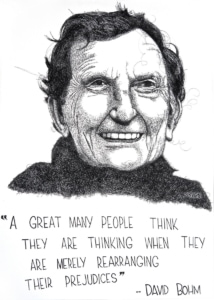 David Bohm (01917 – 01992) was a maverick scientist and thinker who made important contributions to quantum physics and philosophy of thought.
Feeling greatly dissatisfied with the course physics took after the early, groundbreaking discoveries in the quantum domain, he developed an alternative interpretation of quantum physics (“the ontological interpretation”), in which it is possible to actually and meaningfully describe the processes taking place on the microscopic level, introducing new concepts that overcome the wave-particle duality and stressing the holistic aspects of the puzzling experiments.
He also sought a theory that reconciled quantum mechanics with relativity, which was accomplished, albeit very vaguely, with his concepts of “holoflux” aka “holomovement” and “implicate and explicate order”.
Later on, he created new perspectives on the relationship between mind and matter (soma-significance) and spent a lot of time probing the peculiarities of consciousness, in part influenced by conversations with J. Krishnamurti.
Group dialogue also became a focal point, as a means for people to gain insights and deeper understanding collectively and personally.
His quantum proposals been frequently misunderstood by the mainstream, with so-called “Bohmian mechanics” as the most prominent example. In fact, Bohm’s vision of nature was organical, not mechanical.
Interestingly, his ideas are not dead and continue to inspire people in various fields.
David Bohm was not officially considered a philosopher, but his views remain a treasure to explore. They touch all parts of existence, with many subtleties and complexities.
Basil Hiley
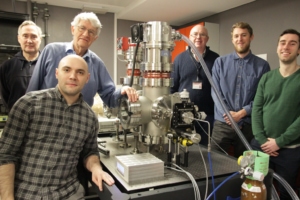
Basil Hiley (2nd fltr) in the lab (source: UCL High Energy Physics group)
Professor Emeritus Basil Hiley (01935 – 02025) furthered the Bohm legacy, mainly working out an algebraic foundation to describe the concepts of process, unfoldment, implicate order, …
At the end of his long career in theoretical physics he started doing lab experiments(!) to help prove his theory.
The main Bohm-Hiley proposals
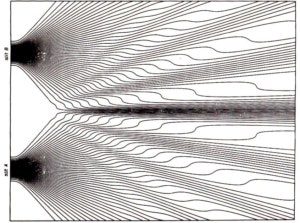
David Bohm speaking about wholeness at Art Meets Science & Spirituality in a Changing Economy (Amsterdam, 01990) (13 minutes)
Some Bohm theory advantages & hypotheticals
Despite the Bohm proposals not being fully examined and understood, let alone accepted by mainstream physicists, they tend to facilitate approaching a lot of ongoing psychological, philosophical and scientific issues, such as:
Recommended books
- “Mind, Matter and the Implicate Order” Paavo Pylkkänen
- “Causality and Chance in Modern Physics” David Bohm
- “The Essential David Bohm” (ed. Lee Nichol)
- “On Creativity” David Bohm
Recommended papers
- Bohm, D. “A new theory of the relation of mind and matter” (01990)
- Hiley, B.J.”Quantum Reality unveiled through Process and the Implicate Order” (02008)
- Pylkkänen, P. “Can Quantum Analogies Help Us to Understand the Process of Thought?” (02014)
Infinite Potential
- “Infinite Potential – The Life and Times of David Bohm” – biography by F. David Peat
- “Infinite Potential” movie

One of the few places in the world and online where David Bohm’s legacy is cherished and actively explored is Pari Center (Tuscany, Italy).
Pari Center for New Learning was founded by the late F. David Peat, friend and collaborator of David Bohm.
Learn more:
David Bohm: een korte inleiding
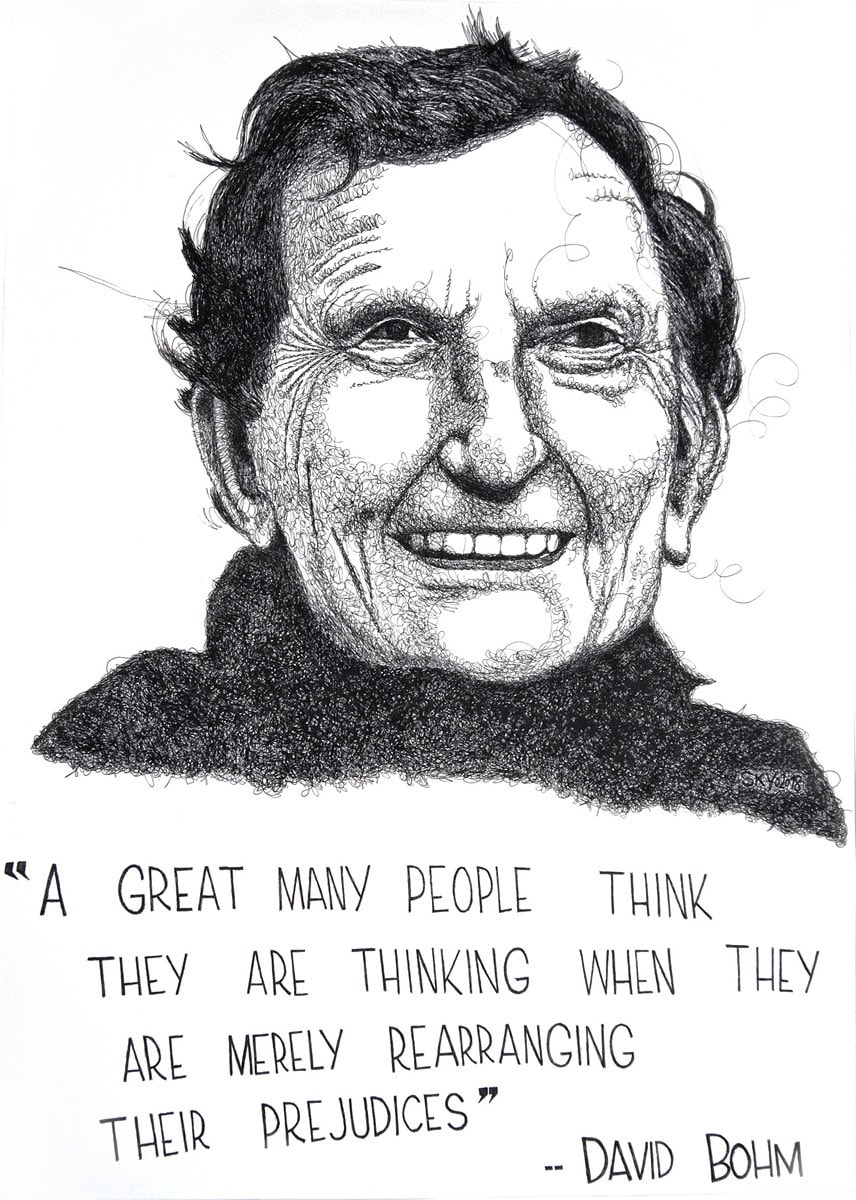 David Bohm (01917, USA) is wellicht een van de grootste denkers van de 20ste eeuw.
Zwaar ontgoocheld door de uitermate wiskundig-theoretische koers van de fysica na de ontdekkingen in het quantumdomein in het begin van de 20ste eeuw ontwikkelde hij een alternatieve interpretatie van de quantum fysica: de “ontologische interpretatie” waarin het mogelijk is te beschrijven wat er werkelijk fysiek gebeurt van moment tot moment (in tegenstelling tot de mysterieuze “wave collapse” en alle bijhorende paradoxen zoals Schrödingers kat).
Daarbij introduceerde hij nieuwe concepten die het mogelijk maken de traditionele golf-deeltje dualiteit te overstijgen en het holistische aspect van de quantum experimenten te verklaren.
Hij zocht ook een theorie die quantum mechanica verzoende met de relativiteitstheorie, wat min of meer lukte met het vage concept van “implicate en explicate orde“.
Later in zijn carrière ontwikkelde hij nieuwe perspectieven op de relatie tussen geest en materie, en ging diep in op de problemen en merkwaardigheden van het menselijke bewustzijn.
Groepsdialoog werd ook een belangrijk onderwerp, als middel om inzicht te verwerven en tot een betere collectieve verstandhouding en een soort groepswijsheid te komen.
Vaak wordt zijn werk verkeerd ingeschat en geïnterpreteerd, met “Bohmian mechanics” als voornaamste voorbeeld. Bohm’s visie van de natuur was namelijk organisch, niet mechanistisch.
Bohm heeft nooit de grote erkenning gekregen die hij ongetwijfeld verdiende (ondanks zijn bijdragen in het onderzoek naar plasma, de quantummechanica, relativiteitstheorie en zijn indirecte bijdrage tot de Stelling van Bell).
Zijn inzichten als filosoof zijn ook zeer waardevol, vol complexiteiten en subtiliteiten.
Bohm’s ideeën blijven mensen uit verschillende domeinen inspireren.
Basil Hiley interview 02021 (34 minutes)
Basil Hiley
Basil Hiley (2nd fltr) in the lab (source: UCL High Energy Physics group)
Professor Emeritus Basil Hiley zet het werk van David Bohm voort, en werkt voornamelijk aan een algebraïsche basis die de concepten van proces, unfolding, quantumpotentiaal, … formaliseert.
De voorbije jaren is hij ook begonnen met onderzoek in het labo(!), in pogingen om de theorie te bewijzen.
David Bohm speaking about wholeness at Art Meets Science & Spirituality in a Changing Economy (Amsterdam, 01990) (13 minutes)
De voornaamste Bohm-Hiley voorstellen
Enkele Bohm theorie voordelen & hypothesen
Ook al is de Bohm theorie zelden bestudeerd of begrepen, laat staan geaccepteerd door mainstream fysici, hij biedt wel enkele oplossingen voor een aantal aanhoudende wetenschappelijke, psychologische en filosofische vraagstukken, zoals:
Recommended books
- “Mind, Matter and the Implicate Order” Paavo Pylkkänen
- “Causality and Chance in Modern Physics” David Bohm
- “The Essential David Bohm” (ed. Lee Nichol)
- “On Creativity” David Bohm
Recommended papers
- Bohm, D. “A new theory of the relation of mind and matter” (01990)
- Hiley, B.J.”Quantum Reality unveiled through Process and the Implicate Order” (02008)
- Pylkkänen, P. “Can Quantum Analogies Help Us to Understand the Process of Thought?” (02014)
Infinite Potential
- “Infinite Potential – The Life and Times of David Bohm” – biography by F. David Peat
- “Infinite Potential” movie
Een van de weinige plekken op aarde en online waar David Bohm’s nalatenschap wordt gekoesterd en actief onderzocht is het Pari Center (Toscane, Italië).
Pari Center for New Learning werd opgericht door F. David Peat, vriend en medewerker van David Bohm.
David Bohm: une courte introduction
David Bohm est sans doute l’un des plus grands esprits du XXe siècle.
Profondément insatisfait de l’évolution de la physique après les premières découvertes révolutionnaires dans le domaine quantique, il a développé une interprétation alternative de la physique quantique (« l’interprétation ontologique »), permettant de décrire concrètement et significativement les processus se déroulant à l’échelle microscopique. Il a introduit de nouveaux concepts qui dépassent la dualité onde-corpuscule et soulignent les aspects holistiques des expériences déroutantes.
Il a également cherché une théorie réconciliant la mécanique quantique et la relativité, ce qu’il a accompli, bien que de manière très vague, grâce à ses concepts d’« holomouvement » et d’« ordre implicite et explicite ».
Plus tard, il a créé de nouvelles perspectives sur la relation entre l’esprit et la matière et a consacré beaucoup de temps à sonder les particularités de la conscience.
Le dialogue de groupe est également devenu un point central, permettant aux individus d’acquérir collectivement des connaissances et une compréhension plus approfondie.
Ses propositions ont souvent été mal comprises par le grand public, la « mécanique bohmienne » en étant l’exemple le plus frappant. En réalité, la vision de Bohm sur la nature était organique, et non mécanique.
Il est intéressant de noter que ses idées ne sont pas mortes et continuent d’inspirer des chercheurs dans divers domaines.
David Bohm n’était pas officiellement considéré comme un philosophe, mais ses idées demeurent un trésor à explorer. Elles touchent à tous les aspects de l’existence, avec leurs subtilités et leurs complexités.
Basil Hiley interview 02021 (34 minutes)
Basil Hiley
Basil Hiley (2nd fltr) in the lab (source: UCL High Energy Physics group)
Le professeur émérite Basil Hiley (01935 – 02025) a perpétué l’héritage de Bohm, en élaborant principalement un fondement algébrique pour décrire les concepts de processus, de développement, d’ordre implicite, etc.
À la fin de sa longue carrière en physique théorique, il a commencé à réaliser des expériences en laboratoire (!) pour étayer sa théorie.
Les principales propositions de Bohm-Hiley
David Bohm speaking about wholeness at Art Meets Science & Spirituality in a Changing Economy (Amsterdam, 01990) (13 minutes)
Quelques avantages et hypothèses de la théorie de Bohm
Recommended books
- “Mind, Matter and the Implicate Order” Paavo Pylkkänen
- “Causality and Chance in Modern Physics” David Bohm
- “The Essential David Bohm” (ed. Lee Nichol)
- “On Creativity” David Bohm
Recommended papers
- Bohm, D. “A new theory of the relation of mind and matter” (01990)
- Hiley, B.J.”Quantum Reality unveiled through Process and the Implicate Order” (02008)
- Pylkkänen, P. “Can Quantum Analogies Help Us to Understand the Process of Thought?” (02014)
Infinite Potential
- “Infinite Potential – The Life and Times of David Bohm” – biography by F. David Peat
- “Infinite Potential” movie
One of the few places in the world and online where David Bohm’s legacy is cherished and actively explored is Pari Center (Tuscany, Italy).
Pari Center for New Learning was founded by the late F. David Peat, friend and collaborator of David Bohm.