
The infinite, moving and undivided whole
Holoflux (holomovement) is the dynamic universe proposed by David Bohm in which everything moves together in an interconnected process.
Here is a quick attempt to clarify what is meant:
reality
= 1) the world of (semi-)autonomous things & cognitive permanence, an abstraction of the actual, infinitely complex context;
2) a simplified map of actuality that helps us survive and thrive as a species;
3) a subset of the content of thought
actuality
= the processes actually taking place underneath/behind the veil of reality, independent of thought
holoflux
= the undivided world of flow & change, the proposed actuality that precedes and includes all possible realities;
the ground of *every thing*

excerpt from comic strip “David Bohm on theory”
Most people think that there is an objective reality that tells us all there is to know or see. This is very questionable. A lot of it is make-belief, some would even call it a consensus trance!
In holoflux, every part is externally related but it is also internally related to the rest through the whole, that is the holistic nature of this perspective. It is also in line with what comes out of quantum theory and the entanglement experiments.
Movement as the ground of all being and becoming
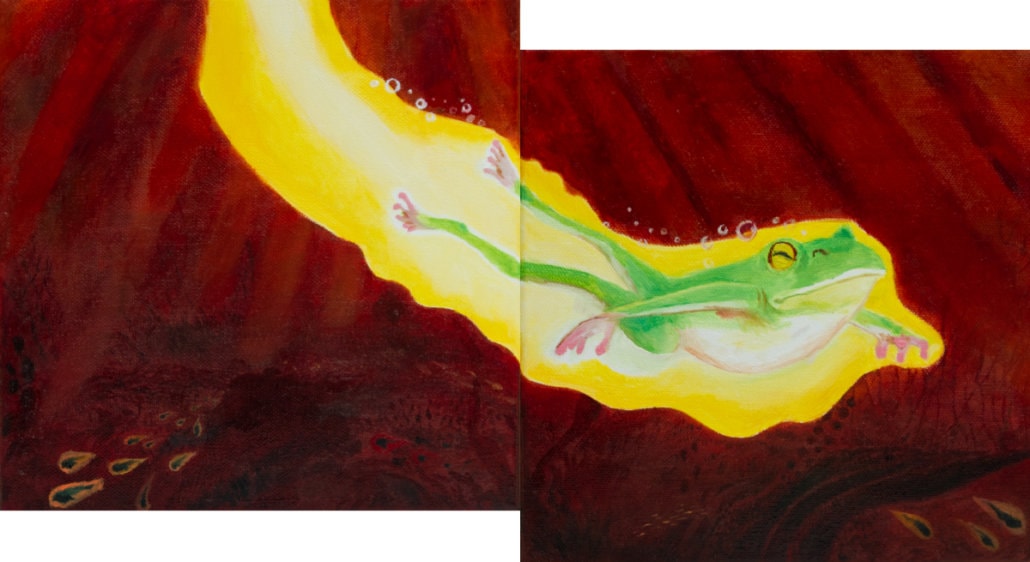
a visual metaphor: jumping in the world of flow (“Basho’s Frog” (detail))
Learn more about this painting.
Holoflux: Codex
 A collection of short meditations on this subject accompanied by some of our artwork is featured in our contribution to the book Holoflux: Codex – Form/Movement/Vision inspired by David Bohm (ed. Lee Nichol, Pari Publishing, 02022, ISBN 8895604369) (available worldwide)
Read a short excerpt from Holoflux:Codex
The explicate order of things…
…presents endless opportunities for imposing an array of perceptual and conceptual filters onto the world, giving us a practical grip on things, resulting in consensus reality. Measurement gives us a certain form of security, an “objective” hold on the world—albeit one fraught with severe limitations. Systematic and habitual fragmentation also provides a certain measure of “security,” as a means to organize and control behavioral and thought patterns.
It should be noted that what the word “holoflux” points to—both in the quantum domain and the realm of nature—also manifests a certain kind of stability. One could argue that the recurrent patterns and rhythms in these domains are in many respects more reliable than those imposed in our attempts to measure and control the flowing world. In this realm of interwoven movements, the physical world does not—as one might fear—completely dissolve to the participating observer, other than for short moments. Rather, what is revealed is the intricate actuality of constant change, small and large.
Nonetheless, the breakdown of static imagery and thought can be scary and disorienting, especially when one initially experiments with holoflux. Practices grounded in the body such as rheosoma, as well as many forms of meditation, can be of great help in adjusting to this flux and flow, enabling one to engage at one’s own pace, with one’s current capacity.
If someone who has not had any early, formative experiences with water is, as an adult, immersed in a large body of water, the immediate reaction will most likely be one of stress and struggle to keep afloat. Rarely is it considered that, under the right circumstance, imagination could be key for that person to relax their mind and body, and to find the right posture to start floating naturally.
While each personal experience with holoflux is different, comparable imaginative remedies are applicable to help adapt to this largely unknown territory. It is not, however, as if one randomly imagines anything whatsoever. Rather, one may imagine, and perceive more directly, aspects of what is unfolding from a more subtle realm. This generative imagining is much more porous and open to the flux from which it arises, and allows for varying qualities to emerge over time, giving rise to a more coherent and adaptive re-creation of reality.
This stands in stark contrast to the replicative imagination that we are taught to conform with from early childhood, having us blindly recreate consensus reality that is subtly rooted in measurement and fragmentation.
In light of all this, it seems quite possible to cultivate “flux permanence” as an active complement to the “object permanence” described by developmental psychologist Jean Piaget. For Piaget, object permanence indicates the ability to remain aware of the fact that an object is still present even when we don’t immediately perceive it. Here, we are proposing that we can develop the ability to remain aware of the fact that movement is still happening, even when we don’t immediately perceive it. As we currently are, subject-object permanence is our collective default. Flux permanence could help to counterbalance this reflexive tendency.As indicated above, the role of the body should not be underestimated when we work with imagination.Turning attention to the internal processes of the body is one of the quickest ways to get in touch with more subtle movements beneath the veil of thought.
Mind is usually considered the realm of greatest subtlety, while body is considered to be coarse, rudimentary, and ignorant. But denying the innate intelligence of the body is pernicious, and has led us into a pervasive mind-body dualism, both individually and collectively. Ingrained cultural assumptions such as these inform consciousness—and the behavior that ensues.
Mind alone is incapable of fully tuning in to holoflux. If, however, we take mind and body to be poles on a spectrum within this flux, an utterly different perspective emerges.When we become rooted in primal body and mind, enacting primal imagination, our organism can begin to move as an integrated whole—and deeper, more far-reaching meanings can unfold.
When intuiting, sensing, connecting, and not-knowing inspire our basic outlook, intellect and measurement can then serve as useful faculties, no longer dominating our engagement with the living world.
From Holoflux: Codex, Chapter “Sky 5” (Sky Hoorne), ed. Lee Nichol, pp. 182-184, Pari Publishing 2023, All rights reserved.

Frequently Asked Questions
Why are we not aware of holoflux?
From a practical standpoint, it should be obvious that we are part of holoflux but usually, our moment-to-moment reality tells us otherwise. Thought tends to take control in every aspect of life and obscure many of the subtleties at play in life, from very trivial to very important ones.
>> A free booklet about this subject with some proposals on how to loosen the grip of thought and consensus trance reality: Entering Bohm’s Holoflux by Lee Nichol (Pari Publishing)
What is the relevance of holoflux in daily life?
We will always need to have some reality (model) in thought as individuals and as a society.
The point of stressing the existence of holoflux and actually, directly experiencing *it* and participating in *it* is to perhaps move toward a more coherent, less fragmented world perspective.
In WEIRD (Western, educated, industrialized, rich & democratic) societies, where computer, tv and mobile screens have taken over a large part of our attention, some counterbalance is called for…!!
How is Bohmian worldview related to some of the other proposed concepts?
Inscendence can be considered a gateway to holoflux, or at least, to get a taste of it and its inherent, felt meaning;
Contexting is simply a part of this immeasurable moving whole within a certain scope, from very small to very large, taking into account the visible and invisible/immeasurable processes that are relevant within that scope
Generative imagination is a faculty that can be developed and trained to narrow the gap between reality and holoflux, to predict the world as it is in a more holofluxing way instead of the dualistic and fragmentary approach
Is "forest bathing" or shinrin yoku an example of (re)discovering holoflux?
Many factors are at play during this kind of activity, a lot having to do with the senses, but in our estimation yes. A lot will depend on the willingness and capacity of the participant(s) to let go of existing preconceptions and fears to engage more deeply with the holofluctic dimensions of existence.
How does this relate to the Pribram-Bohm holoflux theory of consciousness?
The old brain theory formulated by Karl Pribram and inspired by David Bohm’s work in physics should be regarded as something separate from Bohm’s holomovement proposal and the implicate/explicate order framework.
Holoflux is proposed as an actuality, currently and constantly active and *alive* as it were, as the integral all-encompassing process in which every sub-process moves and exists.
Het oneindige, bewegende en ondeelbare geheel
Holoflux (holomovement) is het dynamische heelal voorgesteld door David Bohm waarin alles samen beweegt in een intergeconnecteerd proces.
Hier volgt een beknopte poging ter verduidelijking:
realiteit
= de opgedeelde wereld van (semi-)autonome dingen & gedachten; een abstractie van de werkelijke, oneindige complexe context, een vereenvoudigd begrip van de actualiteit dat ons helpt overleven en voorspoed brengt als diersoort; een onderdeel van de inhoud van onze gedachten
actualiteit
= de processen die werkelijk plaatsvinden achter/onder het projectiedoek van de realiteit
holoflux
= de wereld van flux en verandering, de voorgestelde actualiteit die voorafgaat én alle mogelijke realiteiten bevat; de grond van *alles*
excerpt from comic strip “David Bohm on theory”
De meeste mensen veronderstellen dat er een objectieve realiteit bestaat die alles omvat, al wat er te zien en te weten is. Dit is zeer twijfelachtig. Meer nog, het gaat veelal om aannames die we zelf tot werkelijkheid maken, sommigen noemen het zelfs een ‘consensus trance’ of gedeelde hallucinatie!
Alles in holobeweging is niet enkel extern gerelateerd maar ook intern(!), in relatie tot de rest en het geheel. Dat is de holistische aard van dit wereldbeeld. Het is ook wat kwantumtheorie en de experimenten rond kwantumverstrengeling ons leren.
Beweging als de grond van alle zijn en worden
een visuele metafoor: springen in de wereld van flux (“Basho’s Frog” (detail))
Holoflux: Codex
Een collectie korte meditaties over dit onderwerp voorzien van enkele eigen werken is te lezen in onze bijdrage tot het boek
Holoflux: Codex – Form/Movement/Vision inspired by David Bohm (ed. Lee Nichol, Pari Publishing, December 02022)
Read a short excerpt from Holoflux:Codex
The explicate order of things…
…presents endless opportunities for imposing an array of perceptual and conceptual filters onto the world, giving us a practical grip on things, resulting in consensus reality. Measurement gives us a certain form of security, an “objective” hold on the world—albeit one fraught with severe limitations. Systematic and habitual fragmentation also provides a certain measure of “security,” as a means to organize and control behavioral and thought patterns.
It should be noted that what the word “holoflux” points to—both in the quantum domain and the realm of nature—also manifests a certain kind of stability. One could argue that the recurrent patterns and rhythms in these domains are in many respects more reliable than those imposed in our attempts to measure and control the flowing world. In this realm of interwoven movements, the physical world does not—as one might fear—completely dissolve to the participating observer, other than for short moments. Rather, what is revealed is the intricate actuality of constant change, small and large.
Nonetheless, the breakdown of static imagery and thought can be scary and disorienting, especially when one initially experiments with holoflux. Practices grounded in the body such as rheosoma, as well as many forms of meditation, can be of great help in adjusting to this flux and flow, enabling one to engage at one’s own pace, with one’s current capacity.
If someone who has not had any early, formative experiences with water is, as an adult, immersed in a large body of water, the immediate reaction will most likely be one of stress and struggle to keep afloat. Rarely is it considered that, under the right circumstance, imagination could be key for that person to relax their mind and body, and to find the right posture to start floating naturally.
While each personal experience with holoflux is different, comparable imaginative remedies are applicable to help adapt to this largely unknown territory. It is not, however, as if one randomly imagines anything whatsoever. Rather, one may imagine, and perceive more directly, aspects of what is unfolding from a more subtle realm. This generative imagining is much more porous and open to the flux from which it arises, and allows for varying qualities to emerge over time, giving rise to a more coherent and adaptive re-creation of reality.
This stands in stark contrast to the replicative imagination that we are taught to conform with from early childhood, having us blindly recreate consensus reality that is subtly rooted in measurement and fragmentation.
In light of all this, it seems quite possible to cultivate “flux permanence” as an active complement to the “object permanence” described by developmental psychologist Jean Piaget. For Piaget, object permanence indicates the ability to remain aware of the fact that an object is still present even when we don’t immediately perceive it. Here, we are proposing that we can develop the ability to remain aware of the fact that movement is still happening, even when we don’t immediately perceive it. As we currently are, subject-object permanence is our collective default. Flux permanence could help to counterbalance this reflexive tendency.As indicated above, the role of the body should not be underestimated when we work with imagination.Turning attention to the internal processes of the body is one of the quickest ways to get in touch with more subtle movements beneath the veil of thought.
Mind is usually considered the realm of greatest subtlety, while body is considered to be coarse, rudimentary, and ignorant. But denying the innate intelligence of the body is pernicious, and has led us into a pervasive mind-body dualism, both individually and collectively. Ingrained cultural assumptions such as these inform consciousness—and the behavior that ensues.
Mind alone is incapable of fully tuning in to holoflux. If, however, we take mind and body to be poles on a spectrum within this flux, an utterly different perspective emerges.When we become rooted in primal body and mind, enacting primal imagination, our organism can begin to move as an integrated whole—and deeper, more far-reaching meanings can unfold.
When intuiting, sensing, connecting, and not-knowing inspire our basic outlook, intellect and measurement can then serve as useful faculties, no longer dominating our engagement with the living world.
From Holoflux: Codex, Chapter “Sky 5” (Sky Hoorne), ed. Lee Nichol, pp. 182-184, Pari Publishing 2023, All rights reserved.
Veelgestelde vragen (FAQ)
Waarom zijn we ons niet bewust hiervan?
Vanuit een praktisch perspectief zou het evident moeten zijn dat we deel uitmaken van dit onmeetbare bewegende geheel maar doorgaans vertelt onze realiteit van moment tot moment ons iets anders. Gedachten nemen veelal controle over zowat alle aspecten van ons leven en verhullen veel van de subtiliteiten die spelen in de wereld, van zeer triviaal tot zeer belangrijke processen.
>> Een gratis boekje (engelstalig) over dit onderwerp, met enkele voorstellen om aan de dominantie van gedachten en consensus trance realiteit te ontsnappen: Entering Bohm’s Holoflux by Lee Nichol (Pari Publishing, 02021)
Wat is de relevantie hiervan in het dagelijkse leven?
We zullen altijd een zeker model van de realiteit in gedachten moeten hebben als individuen en als samenleving.
Het benadrukken van het bestaan van holoflux en de mogelijkheid om het direct te ervaren kan helpen om te bewegen naar een meer coherent en minder gefragmenteerd wereldbeeld.
In WEIRD (westerse, opgeleide, geIindustrialiseerde, rijke, democratische) landen, waar computer, tv en mobiele schermen een groot stuk van mensen hun aandacht hebben ingenomen is er een soort tegengewicht nodig….
Is "bosbaden of shinrin yoku een voorbeeld van het (her)ontdekken van holoflux?
Er zijn veel factoren die spelen tijdens dit soort activiteit, en veel heeft te maken met de zintuigen, maar volgens onze inschatting is er zeker een verband of overeenkomst. Veel zal afhangen van de bereidheid en capaciteit van de deelnemer(s) om bestaande gedachten en angsten los te laten en om in diepere interactie te gaan met de holoflux-dimensies van het bestaan.
Le tout infini, mouvant et indivisible
Holoflux (holomouvement) est l’univers dynamique proposé par David Bohm, dans lequel tout évolue ensemble selon un processus interconnecté.
Voici une brève tentative de clarification :
réalité
= 1) le monde des choses (semi-)autonomes et de la permanence cognitive, une abstraction du contexte réel, infiniment complexe ;
2) une carte simplifiée de l’actualité qui nous aide à survivre et à prospérer en tant qu’espèce ;
3) un sous-ensemble du contenu de la pensée
actualité
= les processus se déroulant réellement sous/derrière le voile de la réalité, indépendamment de la pensée
holoflux
= le monde indivisible du flux et du changement, l’actualité proposée qui précède et inclut toutes les réalités possibles ;
le fondement de *tout*
Extrait de la bande dessinée « David Bohm sur la théorie»
La plupart des gens pensent qu’il existe une réalité objective qui nous dit tout ce qu’il y a à savoir ou à voir. C’est très discutable. Beaucoup de ces croyances relèvent de l’illusion, certains allant même jusqu’à parler de transe consensuelle !
Dans l’holoflux, chaque partie est reliée extérieurement, mais aussi intérieurement au reste à travers le tout. C’est la nature holistique de cette perspective. Elle est également en phase avec les résultats de la théorie quantique et des expériences d’intrication.
Le mouvement comme fondement de tout être et de tout devenir
a visual metaphor: jumping in the world of flow (“Basho’s Frog” (detail))
Holoflux: Codex
Un recueil de courtes méditations sur ce sujet, accompagnées de quelques-unes de nos œuvres, est présenté dans notre contribution à l’ouvrage Holoflux: Codex – Form/Movement/Vision inspired by David Bohm (ed. Lee Nichol, Pari Publishing, 02022, ISBN 8895604369) (available worldwide)
Read a short excerpt from Holoflux:Codex
The explicate order of things…
…presents endless opportunities for imposing an array of perceptual and conceptual filters onto the world, giving us a practical grip on things, resulting in consensus reality. Measurement gives us a certain form of security, an “objective” hold on the world—albeit one fraught with severe limitations. Systematic and habitual fragmentation also provides a certain measure of “security,” as a means to organize and control behavioral and thought patterns.
It should be noted that what the word “holoflux” points to—both in the quantum domain and the realm of nature—also manifests a certain kind of stability. One could argue that the recurrent patterns and rhythms in these domains are in many respects more reliable than those imposed in our attempts to measure and control the flowing world. In this realm of interwoven movements, the physical world does not—as one might fear—completely dissolve to the participating observer, other than for short moments. Rather, what is revealed is the intricate actuality of constant change, small and large.
Nonetheless, the breakdown of static imagery and thought can be scary and disorienting, especially when one initially experiments with holoflux. Practices grounded in the body such as rheosoma, as well as many forms of meditation, can be of great help in adjusting to this flux and flow, enabling one to engage at one’s own pace, with one’s current capacity.
If someone who has not had any early, formative experiences with water is, as an adult, immersed in a large body of water, the immediate reaction will most likely be one of stress and struggle to keep afloat. Rarely is it considered that, under the right circumstance, imagination could be key for that person to relax their mind and body, and to find the right posture to start floating naturally.
While each personal experience with holoflux is different, comparable imaginative remedies are applicable to help adapt to this largely unknown territory. It is not, however, as if one randomly imagines anything whatsoever. Rather, one may imagine, and perceive more directly, aspects of what is unfolding from a more subtle realm. This generative imagining is much more porous and open to the flux from which it arises, and allows for varying qualities to emerge over time, giving rise to a more coherent and adaptive re-creation of reality.
This stands in stark contrast to the replicative imagination that we are taught to conform with from early childhood, having us blindly recreate consensus reality that is subtly rooted in measurement and fragmentation.
In light of all this, it seems quite possible to cultivate “flux permanence” as an active complement to the “object permanence” described by developmental psychologist Jean Piaget. For Piaget, object permanence indicates the ability to remain aware of the fact that an object is still present even when we don’t immediately perceive it. Here, we are proposing that we can develop the ability to remain aware of the fact that movement is still happening, even when we don’t immediately perceive it. As we currently are, subject-object permanence is our collective default. Flux permanence could help to counterbalance this reflexive tendency.As indicated above, the role of the body should not be underestimated when we work with imagination.Turning attention to the internal processes of the body is one of the quickest ways to get in touch with more subtle movements beneath the veil of thought.
Mind is usually considered the realm of greatest subtlety, while body is considered to be coarse, rudimentary, and ignorant. But denying the innate intelligence of the body is pernicious, and has led us into a pervasive mind-body dualism, both individually and collectively. Ingrained cultural assumptions such as these inform consciousness—and the behavior that ensues.
Mind alone is incapable of fully tuning in to holoflux. If, however, we take mind and body to be poles on a spectrum within this flux, an utterly different perspective emerges.When we become rooted in primal body and mind, enacting primal imagination, our organism can begin to move as an integrated whole—and deeper, more far-reaching meanings can unfold.
When intuiting, sensing, connecting, and not-knowing inspire our basic outlook, intellect and measurement can then serve as useful faculties, no longer dominating our engagement with the living world.
From Holoflux: Codex, Chapter “Sky 5” (Sky Hoorne), ed. Lee Nichol, pp. 182-184, Pari Publishing 2023, All rights reserved.
Questions fréquemment posées
Quel est le lien avec certains des autres concepts proposés ?
L’inscendance peut être considérée comme une porte d’entrée vers l’holoflux, ou du moins, pour en avoir un aperçu et sa signification intrinsèque et ressentie.
La contexte active est simplement une partie de cet ensemble incommensurable en mouvement, dans une certaine mesure, du plus petit au plus grand, en tenant compte des processus visibles et invisibles/incommensurables qui y sont pertinents.
L’imagination générative est une faculté qui peut être développée et entraînée pour réduire l’écart entre réalité et holomouvement, pour prédire le monde tel qu’il est d’une manière plus holofluxante, plutôt que d’une approche dualiste et fragmentaire.