
The pervasiveness of thought
Thought as a system
“We’re not really aware of what is happening in this system which I’ve called ‘thought’. We don’t know how it works. We hardly know it is a system; it’s not part of our culture even to admit that it is a single system.”
“We started out saying the trouble is that the world is in chaos, but I think we end up by saying that thought is in chaos. That’s each one of us. And that is the cause of the world being in chaos. Then the chaos of the world comes back and adds to the chaos of thought.”
“The reason we don’t see the source of our problems is that the means by which we try to solve them are the source. That may seem strange to somebody who hears it for the first time, because our whole culture prides itself on thought as its highest achievement. I’m not suggesting that the achievements of thought are negligible; there are very great achievements in technology, in culture and in various other ways. But there is another side to it which is leading to our destruction, and we have to look at that.”
from “Thought as a System”, David Bohm, Routledge, 01992
In his later years David Bohm was very involved in the exploration of consciousness, hereby uncovering many of the essential problems of thought.
Looking at the state of humanity, of nature and culture, he saw the intricate enmeshment of what he called “thought as a system” throughout the world, both mentally and physically. 
We can all attest to the fact that human cognition has brought tremendous advancements to humanity. We should also recognize that it has installed a lot of pain, destruction and misery.
Is thought strictly confined to human minds and the socio-economic and cultural realm, or does it extend further…? Upon closer examination of ourselves and the world it becomes apparent that thought and non-thought cannot be strictly separated; there is a constant flow and evolution of active information (= meaning) happening.
Thought and its products have crept into almost every place and aspect of planet earth and its inhabitants.
Human thinking affects the actual, physical world, and the physical processes in turn affect thought.
The more general principle to this is outlined in Bohm’s proposal of soma-significance, which does away with cartesian duality, idealism and materialism.
Perhaps the largest problem of thought lies in its incoherence. Internally it is full of contradictions, externally it is not exactly in harmony with the ways of the natural world…
It is important to stress that incoherence is inevitable; perceptions, assumptions, calculations, interactions,… all can go wrong, and that is not necessarily problematic if we act intelligently and sensitively.
Small incoherences can get corrected afterwards or in near-realtime and are an integral part of living with and within the realm of thought.
Sustained incoherence is the most crucial issue. It needs to be properly addressed and resolved, individually, locally and globally.
Degrees of thought-infiltration & calcification

As indicated, it is impossible to separate thought from non-thought. However, by further examining this Bohmian point of view, we can discern different levels of “thought-infiltration”, i.e. there are different degrees of thought’s impact and influence on a process.
For example, we could consider a tree in a forest planted by humans. Its context is definitely influenced to a large degree by thought (both during the planting and during its lifetime, the soil it is in, its neighboring trees, the air and water it processes, … ).
Nevertheless, we can say that in essence its *treeness* is much more prominent than the influences of thought. Of course, the tree can get chopped down tomorrow!
On the other side of the spectrum we can find a human being so hung up on a certain collection of thoughts that it dulls all spontaneity and liveliness. Their robot-like rigidity takes hold in their body and put further limits on their personal freedom. Thought has become so very calcified that there is little creativity or meaning left in them!
An illustration of one of the fallacies of thought
The Las Vegas lights metaphor
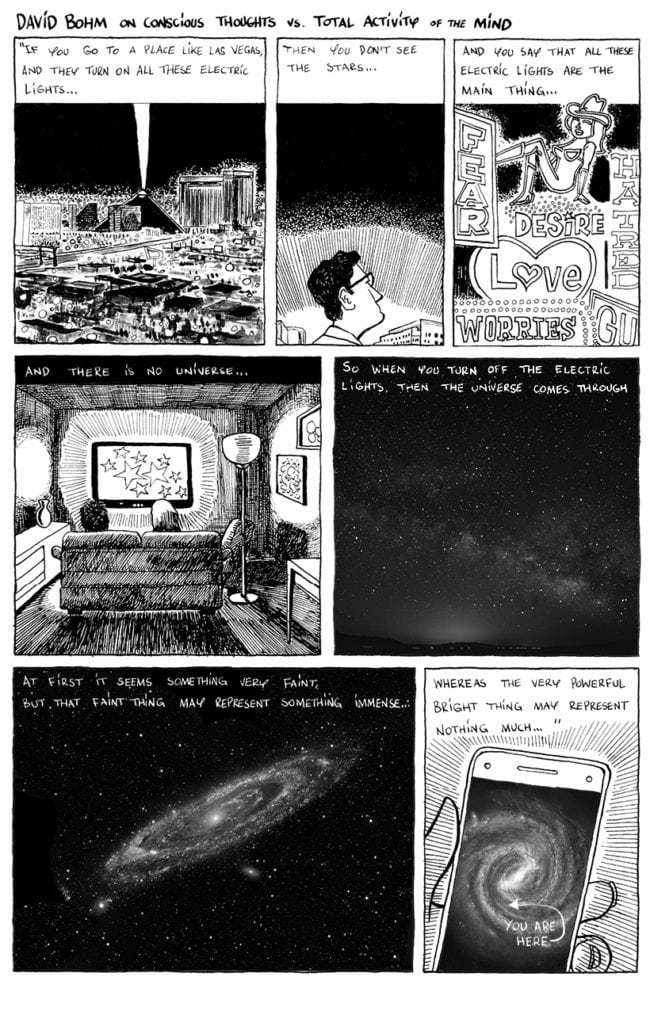
“If you go to a place like Reno, Nevada, or Las Vegas, and we turn on all these electric lights, then you don’t see the stars, and you say that all these electric lights are the main thing, and there is no universe. (laughter) That’s the way obviously feel at that place, right? (laughter) And they blot out the universe.
So when you turn off the electric lights, then the universe comes through. At first it seems something very faint, but that faint thing may represent something immense, whereas the very powerful bright thing may represent nothing much.”
from “Unfolding Meaning – A Weekend of Dialogue” – David Bohm, Routledge, 01985
Ways to loosen the grip of memory and conditioning
Proprioception of thought and more
Bohm saw a way out of the spiral of thought’s perpetuating illusion by the proposal of ‘proprioception of thought’:
Is it possible for thought similarly to observe itself, to see what it is doing, perhaps by awakening some other sense of what thought is, possibly through attention? In that way, thought may become proprioceptive. It will know what it is doing and it will not create a mess.
from “On Dialogue”, David Bohm, 01996
From our perspective (and David Bohm would most likely not have objected), one of the key points to facilitate this would be the role of the body, and to have the body as the primary guide, the proprioception-enabling source.
To inscend our body and the unconscious/prereflective could very well be a way toward balance and a vital inner nature, with thought reduced to its proper role and function. In many instances our intuitions, sensitivities and our innate intelligence can guide us, and thought can assist in those processes without dominating the whole.
At the same time there are also opportunities to find breaks from habitual thought and the consensus trance reality we recreate collectively. We can discover these breaks in contact with nature, in interoception, in the uninhibited playfulness of children, through deeper connections with people, works of art, textures or plain objects even, … Over time these vivid moments that precede or outweigh thought, these glimpses of unfiltered holoflux – positive, negative and everything in between – can affect our outlook on life and the world and even loosen up our self-image and identity.
A free booklet about this very subject with some practical proposals on how to loosen the grip of thought: Entering Bohm’s Holoflux by Lee Nichol (Pari Publishing)
It is important to remember: even when thought should become proprioceptive to a certain degree, incoherence is always one step away.
Thought as a computer system
Artificial intelligence or artificial idiocy?
 Large chunks of thought as a system now exist semi-independently as machine learning entities. Artificial intelligence pretty much boils down to sophisticated algorithms that process enormous chunks of calcified thoughts and thought-like structures. By design it adds, sometimes amplifies existing human biases and it frequently injects baseless noise, digital “fantasy” thoughts.
AI is thought on steroids, with all its twists and turns, capable of making human heads spin, especially when it is responding from the first person.
Any deeper meaning that seems to shine through during communication with a GPT and LLM is principally installed/generated by the user, there is no shared felt meaning as such. Only personalization data is stored on the computer side, and the widely spread dots (in and outside of the body) are connected on the human side. By weighing and averaging out data their originating contexts and meanings get watered down, disfigured or thrown out.
The main goal of this technology is generating responses that please the end user, thereby enhancing user engagement. Accuracy is of far lesser concern.
In short, AI provides a massive source of knowledge, not of steady, deeply rooted wisdom, let alone embodied wisdom.
Frequently Asked Questions
Is it possible to attain some form of proprioception of thought?
The question is more important than the answer, but we do think proprioception of thought is possible to a certain extent. A key element is the role of the body.
Isn’t AI going to show that thought will eventually solve all problems?
As stated, artificial intelligence is pretty much thought on steroids. It is disembodied, it produces noise and falsities, and most importantly, it does not have the capacity to validate or check in on itself, nor the capacity to attune to the living world.
Recommended reading
- “Thought as a System”- David Bohm, Routledge
- Niels Bohr Library & Archives > Oral History >David Bohm – Session XII
- Bohmian Psychology: The Undiscovered Continent of David Bohm’s Worldview – David Moody
De doordringendheid van het denken
Het denken als systeem
We zijn ons niet echt bewust van wat er gebeurt in dit systeem dat ik het ‘denken’ noem. We weten niet hoe het werkt. We weten nauwelijks dat het een systeem is; het is geen onderdeel van onze cultuur om zelfs maar toe te geven dat het één systeem is.
We begonnen met te zeggen dat het probleem is dat de wereld in chaos verkeert, maar ik denk dat we uiteindelijk zeggen dat het denken in chaos verkeert. Dat is ieder van ons. En dat is de oorzaak van de chaos in de wereld. Dan komt de chaos van de wereld terug en draagt bij aan de chaos van het denken.
De reden dat we de bron van onze problemen niet zien, is dat de middelen waarmee we ze proberen op te lossen, de bron zijn. Dat klinkt misschien vreemd voor iemand die het voor het eerst hoort, want onze hele cultuur is trots op het denken als haar hoogste prestatie. Ik beweer niet dat de prestaties van het denken verwaarloosbaar zijn; er zijn zeer grote prestaties op het gebied van technologie, cultuur en op allerlei andere vlakken. Maar er is een andere kant aan die tot onze ondergang leidt, en daar moeten we naar kijken.
uit “Het denken als een systeem”, David Bohm, Routledge, 01992
Gradaties van infiltratie en verkalking van het denken
Zoals aangegeven, is het onmogelijk om gedachten van niet-gedachten te scheiden. Door dit Bohmiaanse standpunt echter verder te onderzoeken, kunnen we verschillende niveaus van “gedachteninfiltratie” onderscheiden, d.w.z. er zijn verschillende gradaties in de impact en invloed van gedachten op een proces.
We kunnen bijvoorbeeld een boom in een bos beschouwen, geplant door mensen. De context ervan wordt zeker in grote mate beïnvloed door gedachten (zowel tijdens het planten als tijdens zijn leven, de grond waarin hij staat, de bomen in de buurt, de lucht en het water die hij verwerkt, …). We kunnen echter stellen dat zijn *boom-zijn* in wezen veel prominenter is dan de invloeden van gedachten. Natuurlijk kan hij morgen omgehakt worden!
Aan de andere kant van het spectrum vinden we een mens die zo gefixeerd is op een bepaalde verzameling gedachten dat het alle spontaniteit en levendigheid afstompt. Gedachten zijn zo verkalkt geraakt dat er weinig creativiteit of betekenis meer in zit!
Het denken als computersysteem: AI
Kunstmatige intelligentie is in feite een geavanceerd leeralgoritme dat simpelweg enorme hoeveelheden verkalkte gedachten en structuren verwerkt. Het is zo ontworpen dat het bestaande menselijke vooroordelen toevoegt, soms versterkt en vaak ongefundeerde ruis injecteert, digitale “fantasiegedachten”. AI is als het denken maar dan opgefokt, het draait en keert en is in staat is om mensen te imponeren, vooral door vanuit de eerste persoon te antwoorden.
In de meeste gevallen schuilt er een diepere betekenis in de gegeven antwoorden. Door data te wegen en tot gemiddelden te herleiden worden de oorspronkelijke contexten en betekenissen afgezwakt, vervormd of weggegooid. De belangrijkste doelen zijn het genereren van betrokkenheid en reacties die de eindgebruiker tevreden stellen; nauwkeurigheid is veel minder van belang.
Kortom, AI biedt een enorme bron van kennis, niet van stabiele, diepgewortelde wijsheid, laat staan belichaamde wijsheid.
“If you go to a place like Reno, Nevada, or Las Vegas, and we turn on all these electric lights, then you don’t see the stars, and you say that all these electric lights are the main thing, and there is no universe. (laughter) That’s the way obviously feel at that place, right? (laughter) And they blot out the universe. So when you turn off the electric lights, then the universe comes through. At first it seems something very faint, but that faint thing may represent something immense, whereas the very powerful bright thing may represent nothing much.”
from “Unfolding Meaning – A Weekend of Dialogue” – David Bohm, Routledge, 01985
Manieren om de greep van het denken te verlichten
Bohm zag een uitweg uit de spiraal van de voortdurende illusie van het denken door het voorstel van ‘proprioceptie van het denken’:
Is het voor het denken mogelijk om zichzelf op dezelfde manier te observeren, te zien wat het doet, misschien door een ander besef van wat denken is te wekken, mogelijk door middel van aandacht? Op die manier kan het denken proprioceptief worden. Het zal weten wat het doet en het zal geen chaos veroorzaken.
uit “On Dialogue”, David Bohm, 01996
Vanuit ons perspectief (en David Bohm zou waarschijnlijk geen bezwaar hebben gemaakt) zou een van de belangrijkste punten om dit te faciliteren de rol van het lichaam zijn, en het lichaam als de primaire gids, de proprioceptie-faciliterende bron.
Het beklimmen van ons lichaam en het onbewuste/prereflectieve zou heel goed een weg kunnen zijn naar evenwicht en een vitale innerlijke natuur, waarbij het denken gereduceerd wordt tot zijn eigenlijke rol en functie. In veel gevallen kunnen onze intuïtie, gevoeligheden en onze aangeboren intelligentie ons leiden, en gedachten kunnen ons bij die processen ondersteunen zonder het geheel te domineren.
Tegelijkertijd zijn er ook mogelijkheden om te breken met onze gebruikelijke gedachten en de consensus-trance-realiteit die we collectief herscheppen. We kunnen deze breuken ontdekken in contact met de natuur, in interoceptie, in de ongeremde speelsheid van kinderen, door diepere verbindingen met mensen, kunstwerken, texturen of zelfs gewone voorwerpen, … Na verloop van tijd kunnen deze levendige momenten die gedachten voorafgaan of overtreffen, deze glimpen van ongefilterde holoflux – positief, negatief en alles daartussenin – onze kijk op het leven en de wereld beïnvloeden en zelfs ons zelfbeeld en onze identiteit versoepelen.
Een gratis boekje over dit onderwerp met enkele praktische voorstellen om de greep van het denken los te laten: Entering Bohm’s Holoflux van Lee Nichol (Pari Publishing).
Het is belangrijk om te onthouden: zelfs wanneer het denken tot op zekere hoogte proprioceptief zou moeten worden, is incoherentie altijd een stap verwijderd.
Frequently Asked Questions
Recommended reading
“Thought as a System”- David Bohm, Routledge
Niels Bohr Library & Archives > Oral History >David Bohm – Session XII
Bohmian Psychology: The Undiscovered Continent of David Bohm’s Worldview – David Moody
Le caractère envahissant de la pensée
La pensée comme système
“Nous ne sommes pas vraiment conscients de ce qui se passe dans ce système que j’ai appelé la “pensée”. Nous ignorons son fonctionnement. Nous savons à peine qu’il s’agit d’un système ; admettre qu’il s’agit d’un système unique ne fait même pas partie de notre culture.”
“Nous avons commencé par dire que le problème est que le monde est en plein chaos, mais je pense que nous finissons par dire que la pensée est en plein chaos. C’est le cas de chacun de nous. Et c’est la cause du chaos du monde. Puis le chaos du monde revient et s’ajoute au chaos de la pensée.”
“Si nous ne voyons pas la source de nos problèmes, c’est que les moyens par lesquels nous tentons de les résoudre en sont la source. Cela peut paraître étrange à quelqu’un qui l’entend pour la première fois, car notre culture tout entière se targue de la pensée comme de sa plus grande réussite. Je ne dis pas que les avancées de la pensée sont négligeables ; il existe de très grandes avancées dans les domaines de la technologie, de la culture et dans bien d’autres domaines. Mais il existe un autre aspect de la question qui mène à notre destruction, et nous devons l’examiner.”
“La pensée comme système”, David Bohm, Routledge, 01992
Degrés d’infiltration et de calcification de la pensée
Comme indiqué, il est impossible de séparer la pensée de la non-pensée. Cependant, en examinant plus en détail ce point de vue bohémien, nous pouvons discerner différents niveaux d’« infiltration de la pensée », c’est-à-dire différents degrés d’impact et d’influence de la pensée sur un processus.
Prenons l’exemple d’un arbre planté par l’homme dans une forêt. Son environnement est indéniablement fortement influencé par la pensée (tant lors de la plantation que tout au long de sa vie, le sol dans lequel il se trouve, les arbres voisins, l’air et l’eau qu’il traite, etc.). Cependant, nous pouvons dire qu’en substance, son caractère arborescent est bien plus important que l’influence de la pensée. Bien sûr, il peut être abattu demain !
À l’autre extrémité du spectre, nous pouvons trouver un être humain tellement obsédé par un ensemble de pensées qu’il émousse toute spontanéité et toute vivacité. La pensée est devenue si calcifiée qu’il ne lui reste plus que peu de créativité et de sens !
La pensée comme système algorithmique: l’IA
L’intelligence artificielle est en quelque sorte un algorithme d’apprentissage sophistiqué qui traite simplement d’énormes fragments de pensées et de structures figées. De par sa conception, elle ajoute, voire amplifie, les biais humains existants et injecte fréquemment du bruit sans fondement, des pensées numériques fantaisistes. L’IA est une pensée sous stéroïdes, tortueuse et changeante, capable de faire tourner la tête, surtout en répondant à la première personne. Dans la plupart des cas, ses réponses recèlent un sens profond. En pondérant et en faisant la moyenne des données, leurs contextes et significations d’origine sont dilués, déformés ou rejetés. L’objectif principal est de générer de l’engagement et des réponses qui satisfont l’utilisateur final ; la précision est une préoccupation bien moindre.
En bref, l’IA fournit une source massive de connaissances, et non une sagesse solide et profondément ancrée, et encore moins une sagesse incarnée.
An illustration of one of the fallacies of thought
“If you go to a place like Reno, Nevada, or Las Vegas, and we turn on all these electric lights, then you don’t see the stars, and you say that all these electric lights are the main thing, and there is no universe. (laughter) That’s the way obviously feel at that place, right? (laughter) And they blot out the universe. So when you turn off the electric lights, then the universe comes through. At first it seems something very faint, but that faint thing may represent something immense, whereas the very powerful bright thing may represent nothing much.”
from “Unfolding Meaning – A Weekend of Dialogue” – David Bohm, Routledge, 01985
A way out…?
Bohm a trouvé une issue à la spirale de l’illusion perpétuelle de la pensée grâce à la proposition de « proprioception de la pensée » :
La pensée pourrait-elle s’observer elle-même, voir ce qu’elle fait, peut-être en éveillant un autre sens de ce qu’est la pensée, par exemple par l’attention ? De cette façon, la pensée pourrait devenir proprioceptive. Elle saurait ce qu’elle fait et ne créerait pas de désordre.
Extrait de « On Dialogue », David Bohm, 1996
De notre point de vue (et David Bohm n’y aurait probablement pas objecté), l’un des points clés pour faciliter cela serait le rôle du corps, et le fait qu’il soit le guide principal, la source de la proprioception.
Inspirer notre corps et l’inconscient/préréflexif pourrait bien être une voie vers l’équilibre et une nature intérieure vitale, la pensée étant réduite à son rôle et à sa fonction propres. Dans de nombreux cas, nos intuitions, notre sensibilité et notre intelligence innée peuvent nous guider, et la pensée peut contribuer à ces processus sans dominer l’ensemble.
Parallèlement, il existe aussi des occasions de rompre avec les pensées habituelles et la réalité de transe consensuelle que nous recréons collectivement. Ces ruptures se découvrent au contact de la nature, dans l’interoception, dans le jeu décomplexé des enfants, à travers des liens plus profonds avec les gens, les œuvres d’art, les textures ou même les objets simples… Au fil du temps, ces instants intenses qui précèdent ou dépassent la pensée, ces aperçus d’holoflux non filtré – positif, négatif et tout ce qui se trouve entre les deux – peuvent influencer notre vision de la vie et du monde, et même affaiblir notre image de soi et notre identité.
Un livret gratuit sur ce sujet, avec des propositions pratiques pour se libérer de l’emprise de la pensée : « Entrer dans l’holoflux de Bohm » de Lee Nichol (Pari Publishing)
Il est important de se rappeler que même lorsque la pensée devrait devenir proprioceptive dans une certaine mesure, l’incohérence est toujours à portée de main.
Frequently Asked Questions
1
Recommended reading
“Thought as a System”- David Bohm, Routledge
Niels Bohr Library & Archives > Oral History >David Bohm – Session XII
Bohmian Psychology: The Undiscovered Continent of David Bohm’s Worldview – David Moody